What To Consider Before Installing Solar Panels on Your Commercial Roof
When you see a commercial building, do you ever stop to think how many thousands of square feet it encompasses? According to the U.S. Energy Information Administration, the national mean floorspace per floor, which heavily dictates footprint/roof area, across commercial buildings is roughly 11,061 square feet. That’s a lot of space, especially since industrial buildings generally skew larger than the overall commercial average.
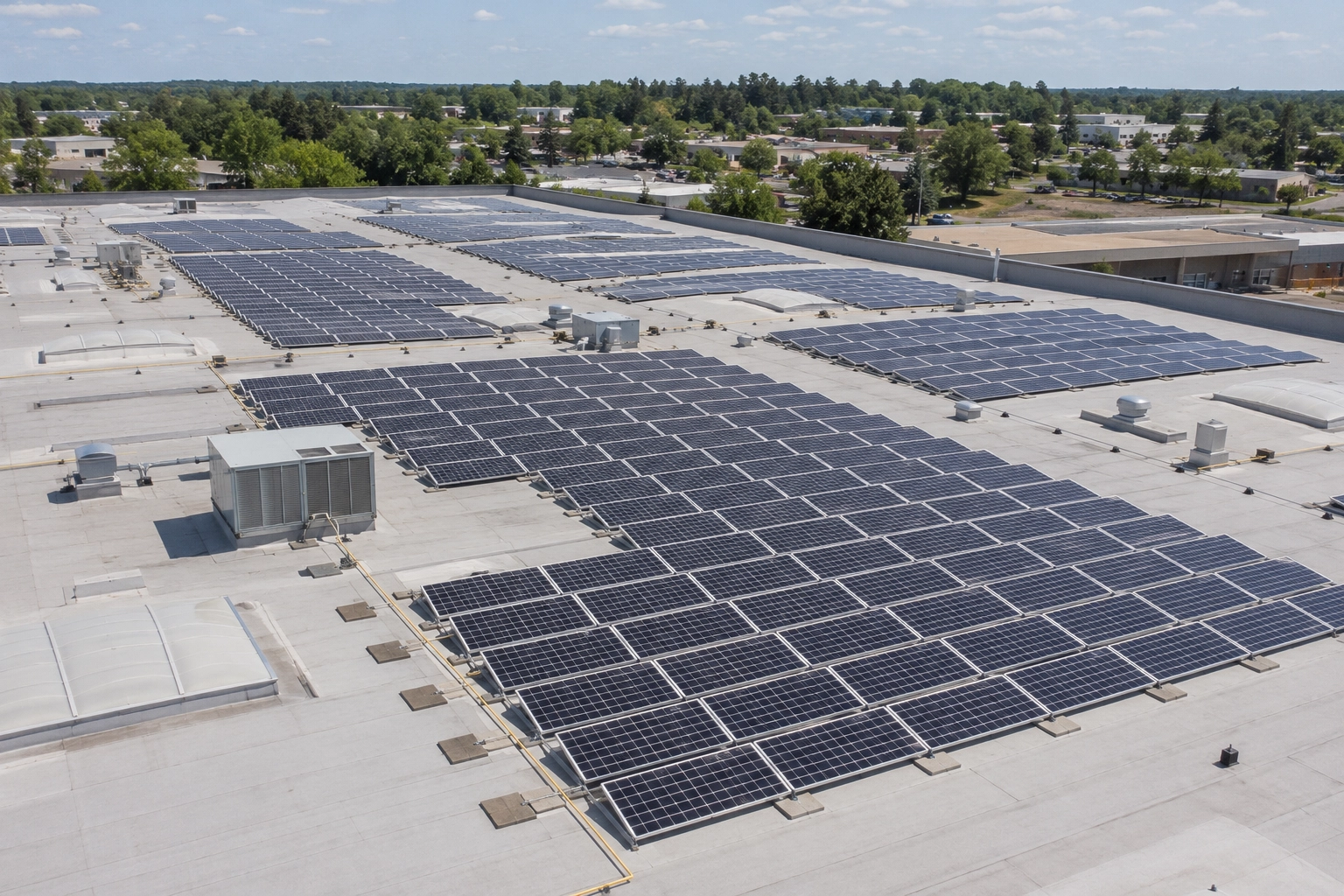
The floor space of these industrial facilities is a hive of activity, but what about the roof deck? With so much unused rooftop space, facility managers might want to consider installing solar panels.
There are several factors to consider before investing in commercial solar panels. In this blog, we will review the benefits of installing solar panels on a commercial roof, the engineering and infrastructure issues to consider, and pro tips to ensure any rooftop solar panel installation is a success.
Benefits of Solar Panels
While there are many benefits, installing solar panels on a commercial roof offers three significant advantages: economic, tax, and environmental.
Economic Benefits
“There are several financial and operational benefits of having solar panels on an industrial roof,” said Bill Morgan, President of Capital 360. “First, electricity is very expensive, and it is typically one of the top three line-item expenses for a commercial building. If a facility can generate its own power with solar panels, facility managers will be able to lower monthly utility bills immediately.”
Second, most commercial buildings consume the vast majority of energy between 8:00 AM and 6:00 PM. Because this energy consumption time perfectly aligns with peak sunlight hours, facilities can generate power exactly when it is most expensive to buy it from the grid.
Tax Benefits
According to the U.S. Department of Energy, there are two tax credits available for businesses for solar energy. The federal Investment Tax Credit (ITC) reduces a facility’s federal income tax liability for a percentage of the cost of a solar system installed during the tax year. The ITC allows commercial building owners to claim a base credit equal to 30% of the total installation costs.
The Production Tax Credit (PTC), on the other hand, is a per kilowatt-hour (kWh) tax credit for electricity generated by solar and other qualifying technologies for the first ten years of a system’s operation, which reduces federal income tax liability and is adjusted annually for inflation.
It’s important to note that facility managers cannot claim both the ITC and PTC for the same property. Solar systems placed in service in 2022 or later or that will begin construction before 2033 are eligible for a 30 percent ITC or a 2.75 ¢/kWh PTC if they meet labor requirements issued by the Treasury Department or are under one megawatt in size.
Environmental Benefits
Solar energy is a clean, renewable source that produces no greenhouse gas emissions, which helps facilities reduce their environmental impact and carbon footprint. Installing solar panels on a commercial facility can also extend a roof’s longevity. That’s because solar panels physically shade the roof membrane directly beneath them. By blocking harsh ultraviolet rays and absorbing the brunt of the weather, solar panels can actually extend the lifespan of the underlying roof material, regardless of the type of commercial roof.
“Because solar panels also absorb the thermal energy from the sun, rather than letting it beat down directly onto a building’s roof, panels also reduce the amount of heat entering a commercial facility,” said Morgan. “This lowers the ambient temperature of the roof surface and reduces the strain on commercial HVAC units during hot summer afternoons.”
Engineering & Infrastructure Issues
If you are considering installing solar panels on your industrial facility, several engineering and infrastructure issues should be considered.
Roof Assessment
“The first thing that should be performed is a commercial roof assessment to evaluate the roof’s structural integrity and condition,” said Steven Fisher, Brand Manager for Capital 360. “The roof must be able to support the weight of the solar panels. If your company doesn’t currently have a commercial roof maintenance plan, contact Capital 360.”
Solar Panels
Once you have a trusted roofing professional to formulate a commercial roof maintenance program, you also need to work with them to review these considerations for the panels at your industrial facility:
- System Sizing: Select the number of solar panels needed and the overall capacity of the system, based on the energy audit and available roof space.
- Electrical Design: Plan the integration of the solar system within your facility’s existing electrical infrastructure. Items to consider include inverters, wiring, and grid connection.
- Permits: Obtain the necessary permits from local authorities, which can include building permits, electrical permits, and grid interconnection agreements.
- Solar Panels and Inverters: Select high-quality solar panels and inverters that will meet your facility’s needs. Consider factors like efficiency, warranty, and brand reputation.
Roof Type
Once you are clear to install solar panels, you need to ensure your facility’s roof type is compatible. Although there are many different commercial building roof types, we believe these are the best roofing materials to support solar panels:
- Standing Seam Metal: Ideal for solar equipment. Allows specialized clamps to attach directly to the raised seams, eliminating the need to drill holes in the roof deck. Preserves the metal’s watertight integrity.
- Thermoplastic Polyolefin (TPO) & PVC Membranes: Highly compatible with solar equipment, but they require specialized approaches. Because these flat or low-slope roofs are prone to wind uplift, non-penetrating ballasted racking systems are typically used for installations. This method uses weighted trays instead of penetrating fasteners to maintain the roofing membrane’s integrity.
- Ballasted or Adhered EPDM: EPDM (rubber) roofs can support ballasted systems, but securing the system requires verifying the building’s structural load capacity to accommodate the added weight of the solar equipment and concrete ballast blocks.
Roof Location & Components
No matter what type of industrial roof you have, its orientation and the available space on top of it should be optimized for solar panel placement. “Maximum sunlight exposure is of critical importance,” said Morgan. “As such, your roof should face south, west, or east; roofs facing these directions are ideal for solar. A north-facing roof will not be effective.” You will also want to consider significant shading from trees or neighboring buildings, which can reduce output by 20–40%, making some roofs poor candidates.
Don’t forget to take a look at your roof deck. If you have too many components on it, such as HVAC systems, this equipment can present issues if there isn’t enough space for the panels. Check out this blog post for more considerations when installing rooftop equipment.
Roof Health
Last but not least, a commercial roof should have at least 10-15 years of remaining life before installing solar panels. “If the industrial roof inspection shows your roofing material should be replaced, this work should be performed before solar panels are installed,” said Fisher. “When it is eventually time for a roof replacement down the road, the solar panels will need to be removed and placed back on top of the roof, which is expensive.”
Pro Tips for High-Yield Solar Panels
Now that you are ready to install solar panels on your commercial roof, here are several pro tips to maximize your solar output and efficiency.
First, conduct a financial analysis. Estimate the total cost for the project, including equipment, installation, permits, and any potential upgrades to your facility’s electrical system. It may take time to save up for this project or to allocate funds in your capital budget properly.
In addition to standard financial considerations, facility managers should also research available tax credits, rebates, and incentives. Financing options, such as loans, leases, power purchase agreements, or Property Assessed Clean Energy financing, may also be available.
Second, it’s important to know how to maintain your roof’s warranty when installing solar panels. Adding penetrations and equipment to any roof on a commercial building can void a warranty if the proper steps and contractors are not consulted. Here are some measures that should be taken to ensure your roof warranty isn’t voided:
- Let your roof warranty company know you are installing solar panels and have them come out to pre-inspect the roof.
- Before the panels are installed, make sure all paperwork is completed and submitted, including the necessary information for the panels you are installing.
- During installation, make sure the panel system is not welded or adhered directly to the roof membrane. Many manufacturers will not honor a warranty if panels are attached this way. Any roof penetrations or anchors must be installed or flashed in accordance with your roof manufacturer’s specifications, and possibly by a certified technician. Make sure penetrations or anchors for solar racking are accessible for a final manufacturer inspection.
- Notify your warranty company when the solar panel installation is complete. They will come out to re-inspect the roof and make note of any repairs that must be made to continue warranty coverage.
Arguably, the most important pro tip is to work with a professional commercial roofing company, such as Capital 360, so we can help you find a reputable solar panel company before engaging in this type of project. “You want to select an experienced solar installer with a proven track record in commercial solar projects,” said Fisher. “Be sure to verify their certifications, references, and insurance coverage.” In addition to managing the installation, your solar contractor should also provide their own inspection, commissioning, and any follow-up or maintenance that is required.
Conclusion
Adding solar panels to a commercial facility is a complex process that requires careful planning, coordination with experts, and adherence to regulations. However, if you know the benefits of installing solar panels on a commercial roof, the engineering and infrastructure considerations to keep in mind, and some pro tips, you can ensure your rooftop solar panel installation is a success.
With the right solar contractor and roofing expert, you can achieve significant cost savings, energy independence, and environmental benefits for your business. For more information or assistance in this process, contact Capital 360.
Sources: