Preparing Commercial Roofing Assets for Winter
Seven strategic considerations for protecting building performance, controlling exposure, and preserving long-term roof value
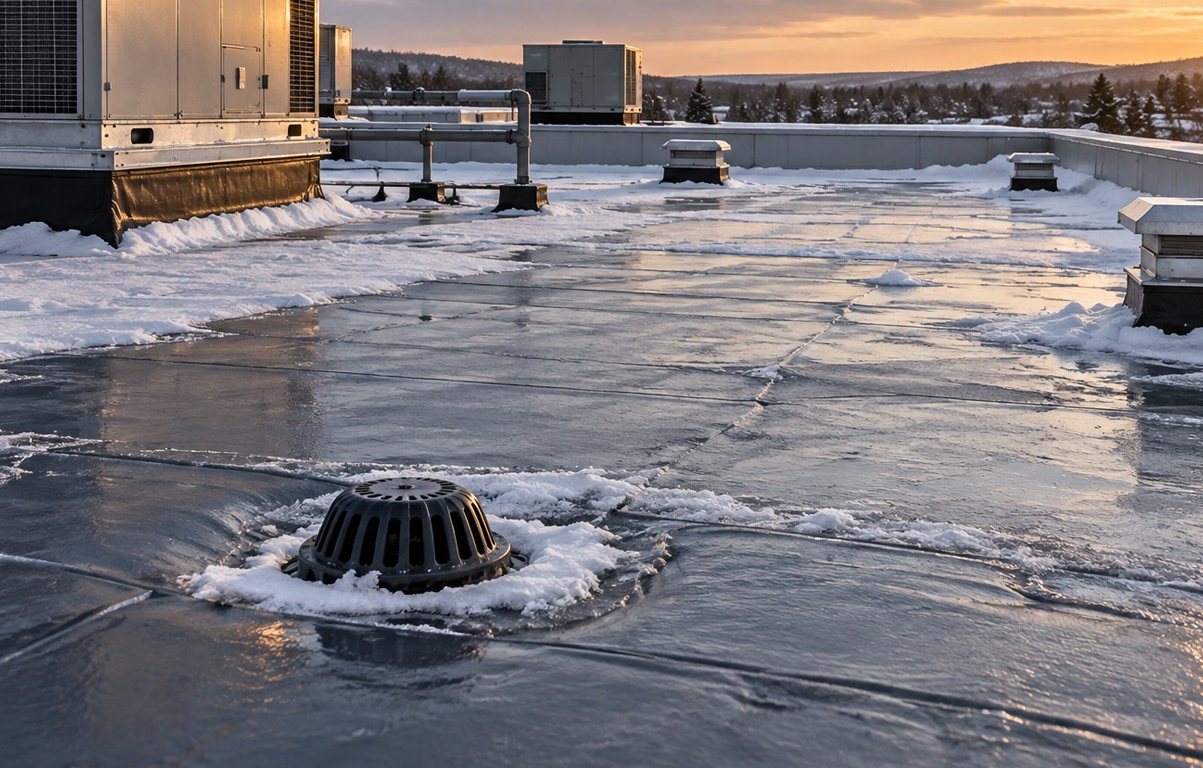
Winter Readiness Is an Asset-Management Decision
For commercial and industrial facilities, winter roof preparation is not simply a seasonal maintenance exercise. It is a decision about risk allocation, operational continuity, and the useful life of a major building asset. A roof that performs adequately during moderate weather may expose underlying weaknesses when drainage is restricted, materials contract, wind loads intensify, or accumulated snow changes loading conditions.
The objective is not to produce a longer inspection checklist. It is to establish which conditions could compromise operations, which corrective actions can materially reduce exposure before winter, and which investments belong in a longer-term capital program. This distinction matters particularly for manufacturers, distribution centers, healthcare facilities, educational campuses, and organizations managing multiple properties.
Capital 360 Inc. approaches winter readiness through the combined lens of roofing-system performance, operational criticality, and life-cycle economics. The following seven considerations provide a framework for evaluating vulnerabilities and directing resources where they will have the greatest impact.
1. Establish a Defensible Baseline of Roof Condition
An effective prewinter assessment should yield more than a list of visible defects. It should establish the roof’s current condition against its installation history, documented repairs, recurring leak patterns, warranty obligations, and expected remaining service life. This approach lets facility leadership distinguish isolated maintenance needs from signs of systemic deterioration.
Critical transitions warrant particular scrutiny: roof-to-wall interfaces, equipment curbs, expansion joints, penetrations, membrane terminations, and perimeter details. Their condition often disproportionately influences water-entry risk. Repeated patching in the same area should prompt an investigation of the underlying cause rather than another isolated repair.
Document inspection findings by location, severity, probable consequence, and recommended response. Photographs, roof plans, and consistent condition categories make subsequent budgeting and contractor accountability more reliable. Where applicable, review manufacturer warranty provisions and approved repair methods before authorizing work; poorly documented interventions can complicate future warranty claims.
2. Evaluate Drainage Performance, Not Merely Drain Cleanliness
Drainage is a system-performance issue. A clear drain does not necessarily mean a roof drains effectively. Persistent ponding, changes in roof slope, displaced insulation, settlement, inadequate overflow provisions, or restrictions in downstream piping may create exposure even when surface debris has been removed.
Facility managers should compare observed drainage behavior with the roof’s design intent and historical performance. Newly recurring ponding is more significant than a familiar, limited residual condition, particularly if it coincides with membrane distress or repeated leaks. Evaluate primary drains, scuppers, gutters, downspouts, and accessible internal drainage components together, and engage plumbing specialists when concealed piping or freeze protection is in question.
Winter intensifies the consequences of impaired drainage. Refreezing can obstruct outlets and retain water where vulnerable details are already stressed. On large low-slope roofs, localized drainage failures can also affect operational areas far from the apparent source. Drainage corrections should therefore be prioritized by downstream consequences of failure, not solely by the cost of cleaning or repair.
3. Assess Thermal Movement at Critical Interfaces
Temperature fluctuations create differential movement across membranes, metal components, equipment supports, and adjoining building materials. The most consequential issues are often concentrated at interfaces rather than in open roof areas.
A prewinter review should consider seam integrity, flashing attachment, termination security, coping joints, counterflashing, and movement accommodation at expansion joints. A detail that survives summer conditions may not perform the same through repeated freezing and thawing. Existing cracks, separation, or loose terminations should be evaluated in relation to the assembly’s construction and movement requirements.
Leak investigation also requires an understanding of concealed water pathways. Interior staining does not necessarily identify the entry point; water may travel laterally through insulation, structural interfaces, or other cavities before becoming visible. Accurate diagnosis reduces the expense and disruption of repeated repairs that treat symptoms rather than causes.
4. Determine Whether Concealed Moisture Changes the Repair Strategy
A roof can look serviceable on the surface while moisture has compromised parts of the underlying assembly. Wet insulation may reduce thermal efficiency and can affect the feasibility and economics of repair, restoration, or eventual replacement.
Recurring leaks, unexplained staining, unusual membrane behavior, and repeated localized repair failures justify a more diagnostic approach. Depending on the roof construction and site conditions, a qualified professional may recommend infrared thermography, moisture surveys, or selective verification. These methods require appropriate conditions and interpretation; no single test should be treated as conclusive in every assembly.
The strategic question is whether the affected area can be repaired reliably, whether wet materials must be removed, and whether findings indicate broader deterioration. That determination influences both near-term winter exposure and the accuracy of future capital forecasts. For facilities with temperature-sensitive processes, inventory, or critical equipment, concealed moisture may also carry consequences beyond the roof itself.
5. Treat Perimeter Integrity as a Wind-Resistance Priority
Roof edges, coping, fascia, and other perimeter assemblies are essential to the overall roofing system’s performance. Loose metal, failed joints, compromised fasteners, or displaced terminations can become especially consequential during severe wind events.
A meaningful assessment considers attachment condition, corrosion, prior wind damage, wall interfaces, and evidence of movement. For metal roofing, evaluation should reflect the particular system’s panel connections, fasteners, flashing, and protective coatings rather than applying membrane-roof criteria indiscriminately.
Do not classify perimeter deficiencies as cosmetic simply because interior leakage has not yet occurred. Their significance depends on exposure, system design, and the potential for localized failure to propagate. When questions arise about wind resistance or attachment adequacy, appropriately qualified roofing or design professionals should evaluate them.
6. Integrate Snow and Ice Exposure Into the Building’s Response Plan
Snow management is a structural and operational issue, not a routine roof-maintenance task. Snow density, drifting, roof geometry, equipment placement, and uneven accumulation can create loading conditions that are not evident from total snowfall alone.
Facility leadership should know where the building’s established snow-load criteria and emergency procedures are documented, who can initiate a response, and which qualified professionals will assess unusual conditions. Buildings with altered rooftop equipment, additions, deterioration, or uncertain structural records may require a structural engineer’s review. Visual impressions of snow depth do not replace a structural evaluation.
Ice accumulation at roof edges, gutters, and outlets can also alter drainage behavior and increase water-entry risk. Any snow-removal operation should follow a site-specific plan that addresses worker safety, membrane protection, access, manufacturer requirements, and coordination with structural professionals as appropriate. Improvised removal can introduce hazards and damage the roofing system.
7. Apply Consistent Portfolio Standards With Site-Specific Risk Adjustments
For organizations operating across Pennsylvania, Maryland, Delaware, and New Jersey, a single maintenance standard creates consistency, but a uniform response may not be appropriate. Roof construction, exposure, age, geometry, operating requirements, and local winter patterns can vary substantially between facilities.
Portfolio managers benefit from a common inspection methodology, condition-rating framework, and reporting format. They should then adjust those standards to reflect each site’s operational criticality and exposure. A warehouse with extensive low-slope roof area may present different priorities from a coastal property subject to wind-driven rain or a manufacturing facility with vulnerable rooftop process equipment.
Comparable condition data allows leadership to identify recurring failure patterns, allocate service resources, and distinguish urgent repairs from projects that can be planned over several budget cycles. It also improves the quality of conversations among facility managers, finance teams, roofing contractors, and insurers.
Convert Findings Into a Risk-Based Work Plan
Inspection findings have limited value until they lead to decisions. A practical winter-readiness program separates immediate hazards and active water entry from preventive corrections and longer-range capital requirements.
Immediate response should address conditions threatening safety, structural integrity, critical equipment, or continuity of operations. Preventive work should focus on deficiencies likely to worsen under winter exposure, such as vulnerable flashings, developing seam failures, deteriorating perimeter details, and drainage restrictions. More extensive moisture damage, widespread aging, or recurring failures may justify engineering review, restoration analysis, or replacement planning.
Prioritize based on both probability and consequence. A modest defect above a sensitive production line may merit faster action than a more extensive problem above a low-consequence area. Likewise, the true cost of a leak may include damaged inventory, interrupted production, interior remediation, employee displacement, and reputational exposure, not simply the roofing invoice.
This framework also helps avoid premature replacement. Evaluate targeted repairs, appropriate restoration options, and planned replacement against condition, remaining useful life, warranty considerations, and total life-cycle cost. The least expensive immediate response is not always the most economical decision over the asset’s remaining service period.
Make Winter Readiness Part of a Continuous Roofing Strategy
The strongest winter programs do not end with a completed fall inspection. They create a documented baseline, assign ownership of corrective work, establish escalation procedures for severe weather, and preserve information that improves future decisions.
Facility teams should maintain accessible records of inspections, repairs, warranty requirements, moisture investigations, and recurring deficiencies. After major weather events, targeted reassessment can help distinguish new damage from preexisting conditions. Over time, this history supports more accurate forecasting and more defensible decisions about repair, restoration, and replacement.
Capital 360 Inc. works with commercial and industrial facility owners and managers to evaluate roofing conditions, prioritize corrective action, and align maintenance programs with operational and capital objectives. For organizations seeking to reduce winter exposure while protecting the long-term value of their roofing assets, the most productive starting point is a condition-based assessment and a clearly prioritized plan.
To discuss winter readiness, roofing inspections, or a commercial roof maintenance strategy, contact Capital 360 Inc. through capitalroofcare.com.