More Than a Roofing Contractor: The Capabilities Behind Capital 360 Inc.’s Roofing Division
For the facility manager responsible for several million square feet of real estate, roofing isn’t simply a construction issue. It’s an asset-management issue.
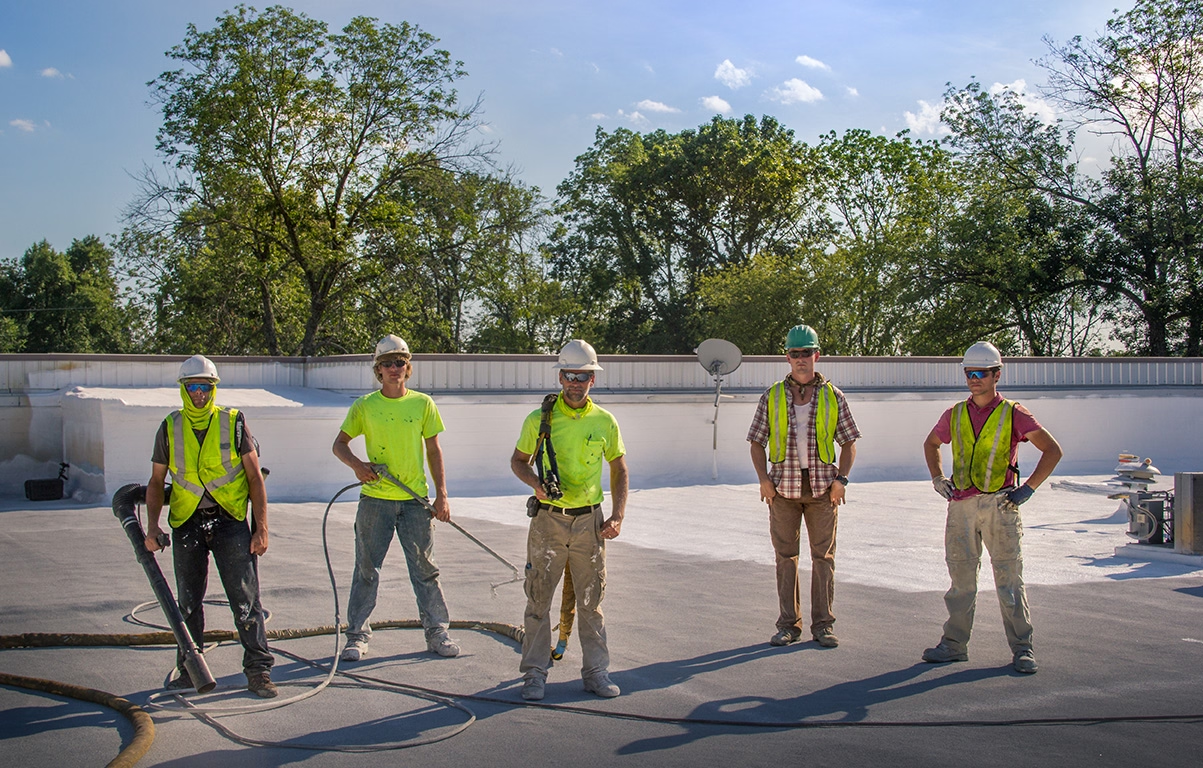
A commercial roof protects production equipment, inventory, employees, building systems, and, ultimately, the continuity of the operation beneath it. A roof failure at a manufacturing plant, distribution center, pharmaceutical facility, school campus, or food processing operation can have consequences far beyond the cost of repairing the roof itself. That changes the conversation facility professionals should be having with their roofing contractors.
The question isn’t simply, Can you repair or replace this roof? It is: Can you help us manage this asset intelligently over its entire service life? That distinction is central to the approach of Capital 360 Inc.’s Roofing Division.
With more than 30 years of experience, Capital 360’s Roofing Division provides commercial and industrial roofing services ranging from inspections and preventive maintenance to emergency repair, restoration, fluid-applied roofing systems, and complete replacement. The company’s experience encompasses metal, EPDM, TPO, single-ply, foam, tar-and-gravel, flat and steep-slope roofing systems, among others.
But its broader capability is not defined by how many different types of roofs it can install. It is defined by how Capital 360 approaches the roof as a long-term facility asset.
As Founder and CEO Mervin Fisher puts it: “We assess each roof, balance safety and budget, and propose the best solution at the best price.” That philosophy has shaped Capital 360 from its beginnings into the commercial and industrial contractor it is today.
More Than 30 Years of Commercial and Industrial Experience
Capital 360 traces its roots to the early 1990s, when Mervin Fisher began building the company that eventually evolved into today’s organization. The company’s early work included painting agricultural and commercial structures. Over time, its capabilities expanded into industrial coatings, commercial roof coatings, flooring, and eventually comprehensive commercial roofing services.
That history matters because coatings weren’t an add-on that Capital 360 discovered after becoming a roofing contractor. They were part of the company’s technical foundation.
According to Brand Manager Steven Fisher, Mervin Fisher was applying commercial roof coatings as far back as the early 2000s as an alternative for facilities where coating could extend roof life more economically than replacement. Capital 360 later expanded into roof replacement and conventional re-roofing, ultimately building a full-service roofing operation encompassing inspection, maintenance, restoration, emergency repair, and replacement.
Today, those capabilities operate under the unified Capital 360 Inc. identity. That evolution also explains why the company’s view of roofing differs from contractors whose primary business model revolves around replacement.
The Objective Isn’t to Sell a New Roof. It’s to Make the Right Capital Decision.
A roof replacement can represent a significant capital expenditure, particularly across a portfolio containing hundreds of thousands—or millions—of square feet of roofing. Sometimes replacement is unquestionably necessary. Sometimes it isn’t. Capital 360 evaluates existing roof conditions before deciding whether maintenance, targeted repair, restoration, or replacement is the right course of action.
“Unlike many other companies, Capital 360 won’t recommend roof replacement unless other options won’t be cost-effective or provide the protection you need,” says Bill Morgan, President of Capital 360. That distinction matters.
A facility manager should not have to determine in advance which roofing product or construction method is needed. The contractor should diagnose the condition, understand the facility’s operational requirements, and help determine which solution best balances performance, risk reduction, and lifecycle value.
Capital 360 describes its approach as consultative rather than product-driven. Steven Fisher summarizes it this way: “We ask our customers, ‘How can we build the right system for your project?’ Then we find the best solution, so our customers get the longest lifespan and the most value from their building systems.” For sophisticated facility organizations, that difference matters.
Standard, Modified and Fully Custom Roofing Systems
Not every commercial roofing project requires the same level of engineering or customization. Capital 360 organizes its capabilities around three broad types of solutions.
- Standard systems provide proven approaches for relatively straightforward roofing applications where specialized modifications aren’t necessary.
- Made-to-order systems adapt proven roofing solutions to a facility’s specific operating conditions. That could mean additional insulation for cold storage, for example, or enhanced chemical resistance at a manufacturing facility.
- Custom systems address unusual structures or performance requirements where conventional solutions are insufficient. These can include historic structures requiring aesthetic preservation, facilities with environmental requirements, or buildings containing complex architectural conditions.
The point isn’t customization for customization’s sake. It is avoiding the opposite problem: forcing every building into the contractor’s preferred roofing system. That becomes particularly important in large industrial environments where roof performance may be affected by chemicals, heat, vibration, process exhaust, extensive mechanical equipment, unusual drainage conditions, high foot traffic, or hundreds of penetrations.
Experience in Demanding and Regulated Facilities
The technical requirements for maintaining a warehouse roof differ from those of a pharmaceutical plant, food processing operation, or heavy manufacturing facility.
Capital 360 has deliberately developed experience within demanding commercial and industrial environments. The company’s markets include manufacturing, warehousing and distribution, education, pharmaceutical facilities, food and beverage operations, cold storage, government and municipal facilities, and other heavy industrial applications. Regulated environments are a particular focus.
“We love working in regulated industries,” Steven Fisher says. “Any industry that requires detailed paperwork or regulations that need to be followed is our specialty.” That experience becomes increasingly important as facility complexity increases.
A roofing project at an operating manufacturing or pharmaceutical facility isn’t occurring in isolation. Contractors may need to work around production schedules, employees, equipment, environmental requirements, access restrictions, and other contractors while minimizing disruption.
For example, a recent project was a 300,000-square-foot cannabis facility restoration performed to maintain FDA compliance. The company has also performed long-term roofing work for educational facilities and developed specialized solutions for complex entertainment properties.
For a facility executive, the underlying capability matters more than any individual project: the ability to execute roofing work in environments where the operation underneath the roof must keep functioning.
Inspection and Preventive Maintenance: Managing Problems Before They Become Projects
Some of the highest-value roofing work prevents a major roofing project. Capital 360 conducts comprehensive inspections intended to identify deterioration while problems are still manageable. Inspections can include checking fasteners and components, examining seams and cracks, identifying areas susceptible to ponding water, looking for movement within the roofing system, and examining rooftop equipment and drainage systems.
That information provides facility teams with something far more useful than a pass/fail assessment. It creates visibility. A roof may have ten years of useful life remaining overall while still needing attention in several areas within the next twelve months. Another portion may warrant restoration in three years. A drainage problem may need immediate correction even though the membrane remains sound.
Understanding those distinctions enables maintenance and capital budgets to be developed around actual conditions rather than surprises.
From Reactive Roofing to Lifecycle Roof Management
That philosophy is formalized through Capital 360’s Capital Asset Program, a tiered roof lifecycle-management program designed for individual facilities and organizations managing multiple buildings.
Depending upon the service level, capabilities include 54-point roof condition and maintenance assessments, warranty documentation, service-work-order tracking, maintenance and repair recommendations, online roof information, roof reports, CAD drawings, roof core testing, advanced condition cataloging, infrared imaging assessments, and annual repair and maintenance budget planning.
Capital 360’s online client portal can also centralize warranty information, condition assessments, recommendations, work orders, before-and-after photographs, and other roof records.
For a multi-site facilities organization, this moves roof management closer to a portfolio-level asset management program.
Instead of:
Leak → service call → repair → repeat
… the process becomes:
Inspect → document → prioritize → budget → maintain → repair or restore → reassess.
That difference can be substantial when managing multiple facilities. It also gives facility leaders better information when presenting capital requests to finance executives, ownership, or a board. Instead of saying, “We think Building 4 may need roofing work next year,” management can provide documented conditions, repair histories, projected needs, and budget recommendations.
Managing the Warranty Is Part of Managing the Roof
For a large facility organization, installing a warranted roofing system is only the beginning. Keeping that warranty in force for the next 10, 15, or 20 years can become a significant management responsibility. Different buildings may have different manufacturers, contractors, roofing systems, coverage periods, inspection schedules, and documentation requirements. Across a multi-building or multi-site portfolio, those obligations can quickly become difficult to track.
Capital 360 Inc. helps facility teams manage that complexity through its broader roof lifecycle-management approach. That begins with understanding exactly what each warranty covers—and what it doesn’t. Commercial roof warranties can range from material-only and workmanship warranties to full-system and No-Dollar-Limit (NDL) coverage. Terms can differ substantially regarding labor, materials, exclusions, prorated coverage, transferability, and claims procedures. Capital 360 helps organize this information so facility managers have a clearer picture of the protection tied to each roofing asset.
Just as important are the ongoing obligations required to preserve the warranty. Many manufacturers require annual or semiannual inspections, prescribed maintenance, and documentation of the work performed. Unauthorized repairs, incompatible materials, unapproved alterations, poor maintenance, or failure to report a problem within the required period can potentially compromise warranty coverage. Even something as routine as adding rooftop equipment or allowing another contractor to modify the roofing system can create warranty issues if the work isn’t handled according to the manufacturer’s requirements.
For a facility manager responsible for a large portfolio, roofing administration becomes almost as important as roofing installation. Capital 360’s service plans can include organizing warranty information, tracking maintenance requirements, regularly assessing roof conditions, and documenting maintenance assessments and repair activity.
Facility teams can also maintain information through an online portal, giving them 24/7 access to roof maintenance records and related information.
Documentation Matters When a Claim Arises
The value of that recordkeeping may not become apparent until something goes wrong.
Commercial roof warranty claims commonly require documentation such as photographs, inspection reports, and maintenance records, and some warranties require reporting problems within a specified period. Performing unauthorized repairs before notifying the warranty provider can also jeopardize a claim. A well-maintained history therefore gives a facility organization something extremely valuable: a documented chain of stewardship showing how the roofing asset has been inspected, maintained, and repaired.
That can be especially important after personnel changes. A roof installed 12 years ago may outlast the facility manager who authorized it, the maintenance personnel who cared for it, and even the company’s current ownership structure. Critical warranty knowledge shouldn’t reside in someone’s inbox, filing cabinet, or memory. Capital 360’s approach creates continuity by making roof history, warranty requirements, and maintenance documentation part of an organized asset-management process.
Manufacturer Relationships Add Another Layer of Support
Capital 360’s relationship with American WeatherStar further strengthens this capability for facilities using its fluid-applied restoration systems. American WeatherStar offers different warranty levels, including material warranties and NDL system warranties. Its Elite NDL option, for example, carries specific inspection and documentation requirements.
Capital 360’s familiarity with those requirements helps clients think beyond obtaining a warranty at project completion to maintaining the conditions necessary to protect that warranty throughout its term.
For facility executives overseeing a large real-estate portfolio, the objective is bigger than keeping warranty certificates on file. It’s knowing which roofs are covered, what they cover, when coverage expires, what maintenance is required, what work has been performed, and what comes next.
That’s another way Capital 360 moves the relationship beyond the traditional contractor model. The company isn’t simply installing a roofing system and handing the facility manager a warranty binder at the end of the project. It can remain involved throughout the warranty period, helping protect the roof, the warranty, and the capital investment behind both.
Restoration as a Capital-planning Tool
One of Capital 360’s strongest technical capabilities is commercial roof restoration using fluid-applied systems. When existing roof conditions permit, restoration can provide an alternative to tearing off and replacing an otherwise viable roofing assembly.
This is where Capital 360’s longstanding relationship with American WeatherStar becomes particularly significant.
Capital 360 has achieved Platinum Elite Contractor status with American WeatherStar, reflecting training and experience with the manufacturer’s fluid-applied restoration systems. Members of Capital 360’s roofing team also participate in American WeatherStar’s FAST—Fluid-Applied System Techniques—training program, which combines classroom instruction with hands-on training involving coatings, equipment, chemistry, and substrate preparation.
Capital 360’s experience includes acrylic, silicone, urethane, and fluid-applied reinforced roofing solutions. Depending upon existing conditions and system selection, these technologies can be used on metal, single-ply, modified bitumen, built-up roofing, and other substrates.
For Mervin Fisher, the manufacturer relationship extends beyond the product itself. “Not only are American WeatherStar’s products the best in the industry, but their customer support has also been, bar none, the best.”
That manufacturer-contractor relationship provides another layer of technical resources behind the field installation. And because a restored roof may be recoated later, restoration can become part of a longer lifecycle strategy rather than a one-time repair.
Repair Capability When the Roof Can’t Wait
Even the best-managed roofing portfolio will occasionally experience an event that wasn’t in the capital plan. Wind. Hail. Falling debris. Ice. Drainage failures. Mechanical damage. A failed penetration.
Capital 360 maintains 24/7 emergency contact availability and prioritizes urgent roofing problems. Its documented repair process begins with inspection and diagnosis, followed by a consultation on repair options, then execution of the selected repair.
That diagnosis-first approach is important. Finding where water appears inside a building does not necessarily identify where water entered the roofing system. On large industrial roofs containing drainage systems, curbs, HVAC equipment, piping, and numerous penetrations, tracking the actual source of a leak can require systematic investigation. The goal should not simply be to make the leak disappear today. It should be to understand why it occurred and what to do to keep it from recurring.
Replacement When Replacement Is the Right Answer
Lifecycle management does not mean avoiding replacement indefinitely. Every roofing system eventually reaches a point where additional repairs or restoration no longer represent sound asset management.
When that point arrives, Capital 360 provides complete commercial roof replacement based on the building’s construction, existing conditions, operational needs, and budget. Its replacement capabilities encompass a broad range of commercial roofing materials and configurations.
The difference is that replacement becomes the outcome of an evaluation—not the starting assumption. For facility managers accountable for both operational risk and capital expenditure, that is exactly how the decision should be made.
A Roofing Division Backed by Broader Building-Envelope Capabilities
Perhaps the biggest distinction between Capital 360 and a traditional roofing contractor is found outside the roof itself. The roofing operation is part of a broader commercial and industrial facility-services organization.
Capital 360’s capabilities extend into commercial and industrial painting and coatings, waterproofing, industrial epoxy flooring, sandblast cleaning, and related building protection services. The organization also works with its building envelope consulting capabilities to help clients develop strategies for maintaining roofs, walls, floors, and other critical building assets. That creates a more holistic perspective.
Water intrusion, corrosion, and building deterioration do not respect the organizational boundaries between “roofing,” “walls,” “coatings,” and “flooring.” The strategy for protecting the facility shouldn’t either.
The Scale of the Facility Changes. The Objective Doesn’t.
A facility manager overseeing a manufacturing plant has different requirements than someone responsible for a school district, pharmaceutical operation, or multi-building distribution portfolio.
The roofing systems may differ. The regulatory environment may differ. The consequences of downtime may differ dramatically. But the objective remains remarkably consistent: protect the facility, understand the condition of the roofing asset, control lifecycle cost, and intervene before manageable problems become major capital events.
That is the role Capital 360 Inc. is positioning its Roofing Division to fill. Not simply as the contractor that arrives when water is coming through the ceiling, but as a technical resource that can inspect, document, maintain, repair, restore, and ultimately replace commercial roofing systems as conditions require.
Steven Fisher describes the company’s differentiators simply: “Service, communication, and value.”
For experienced facility professionals, those words have practical meaning: understand the building, document what you find, recommend the appropriate solution, communicate clearly, execute safely, and provide enough information to make the next capital decision intelligently. That’s a considerably higher standard than simply installing roofs. And for organizations responsible for large, complex, or mission-critical facilities, that standard matters.